As a spiritual seeker, what is your response when asked what you want? Do you unhesitatingly proclaim, “I want the truth,” “I want enlightenment,” “I want certainty”? Do you want peace, rest, bliss, or happiness? power or knowledge? What other less exalting wants flicker in your mind? Are you actively striving for security, a mate, or creature comforts? Be honest about the motivations behind your actions. If we didn’t have needs, we wouldn’t fire a neuron or flex a muscle.
The psychologist Abraham Maslow explored wants and needs as motivators. Here is his hierarchy of needs (I consider want and need synonymous terms):
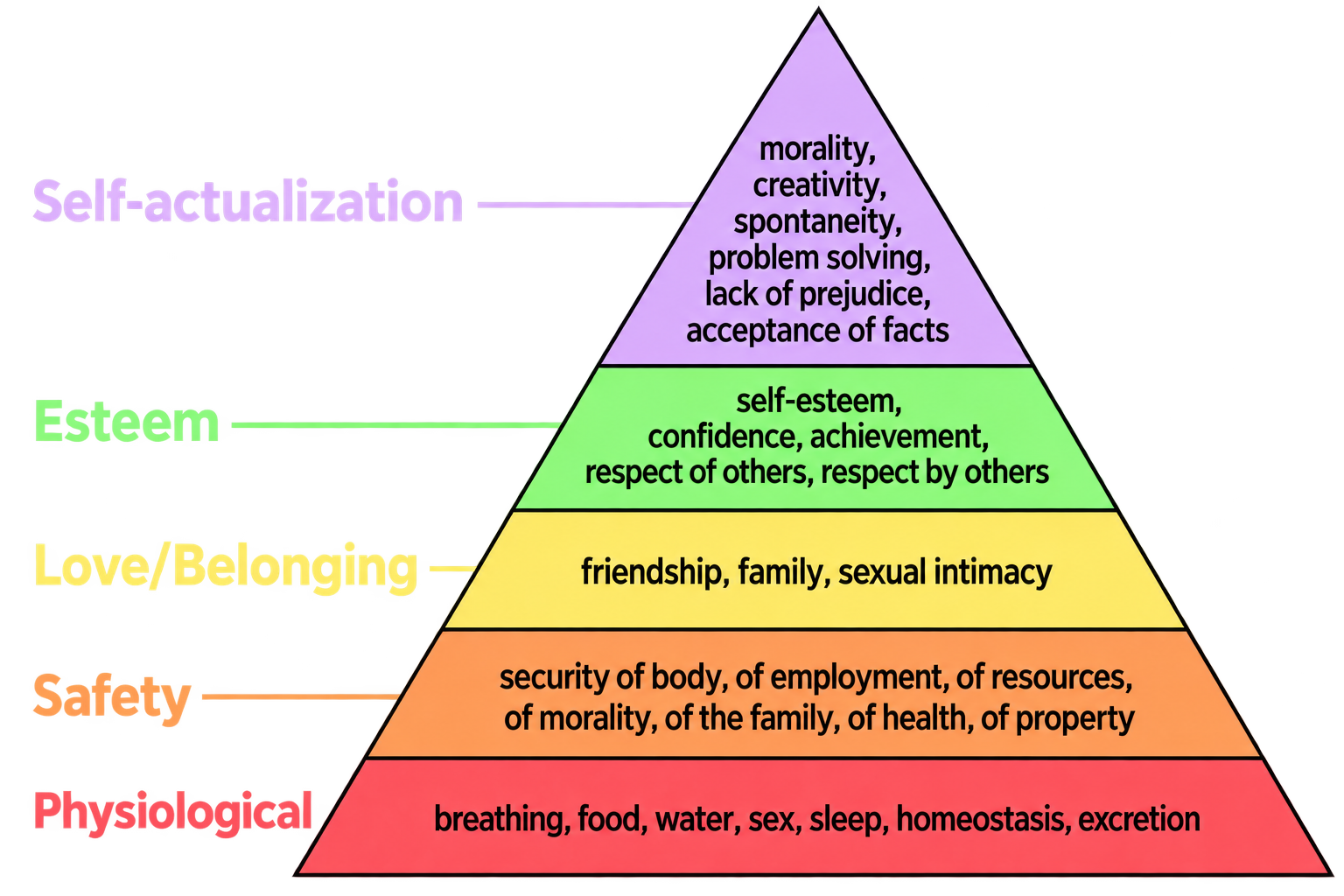
It’s a good representation of motivators and at the tip top of the pyramid, though it’s not shown above, Maslow inserted “spiritual needs.”
At a recent workshop, several people answered the question, “What do you want?” by saying “I want to know what I want.” That’s a fairly honest answer indicating familiarity with the changing, conflicting, and multi- pronged variety of our wants. It is also procrastination.
Your body was born and immediately began wanting, hungering, and searching for fulfillment in the exterior world. As the body ages, its wants change, but a thread and theme unites them all. What is the fundamental want, the source of all desire for action?
By inverting Maslow’s pyramid, we trace every want back to its source: the spiritual need.
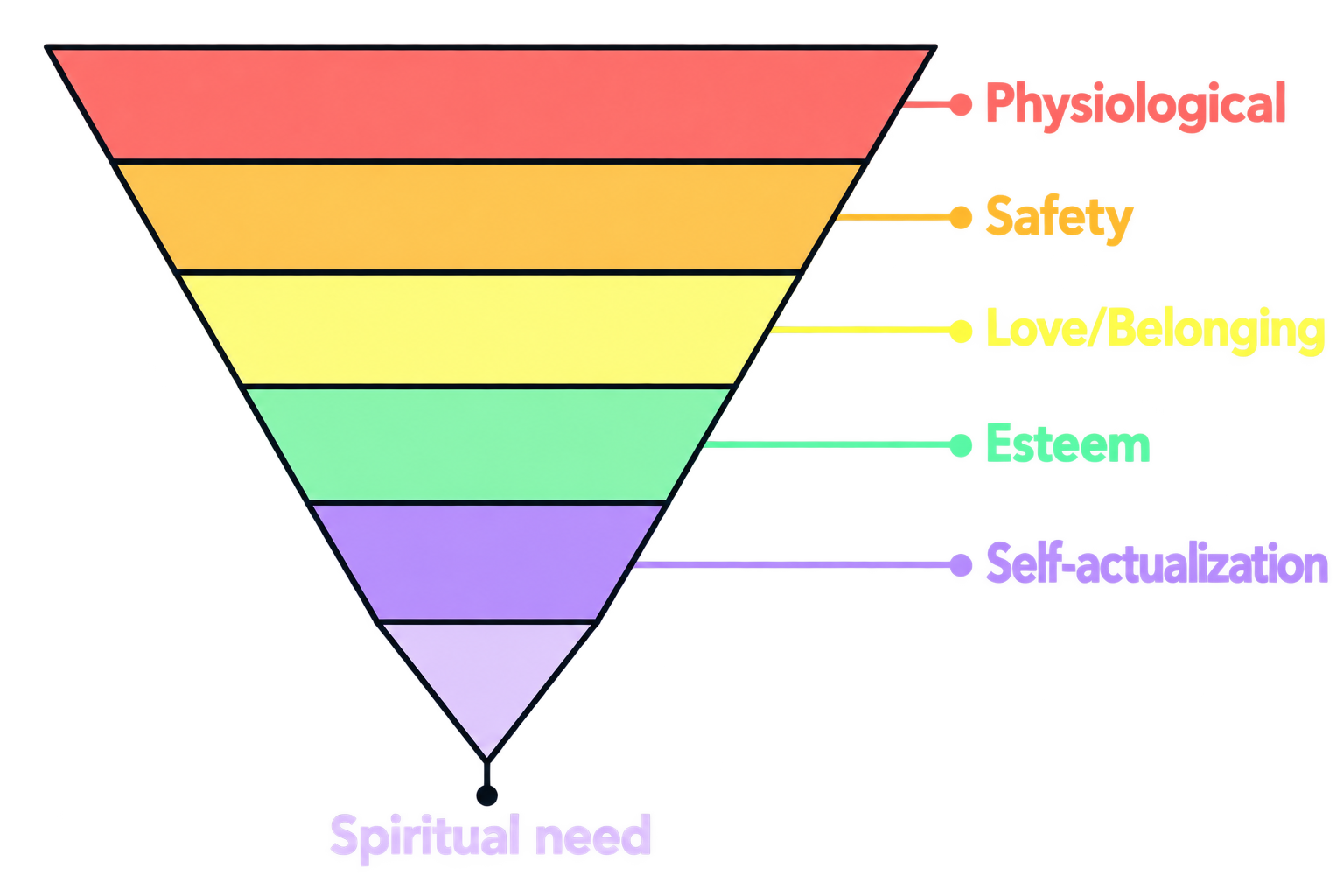
Imagine a flow of action extending up and out from the triangle’s apex. Our most obvious motivations are farther from the source, but closer to the surface and more visible – the physiological needs. Our spiritual path is to work our way down the triangle by backing away from lesser wants. Spiritual practices often include a period of denying wants through fasting, celibacy, solitude, and other “ascetic” practices. Satisfying all of our lesser needs does not move us towards a spiritual realization. We don’t work our way through the pyramid by satiation. This inverted pyramid also illustrates why Maslow noted transcendent experiences occurring throughout his hierarchy – the spiritual need is the source of human existence rather than the culmination.
The fundamental need is always spiritual. I spent six years in college studying soil science because I saw a beautiful picture of rolling, green pastures in a college handbook. I longed to be in that moment of verdant perfection. At the time, I couldn’t have parsed those feelings. I chased a degree to chase a dream connected with those pictures. I did not, I could not, have asked my self why. I would not have understood the process of finding the need behind my reaction to pictures of nature. I’d never heard of Maslow, or the spiritual search. But you have.
It took six years for me to realize I did not want to be sitting under a tree in a postcard field of grass. What I wanted was the feeling of completeness that arose when I saw (or imagined) the picture. You have to seek the fundamental need. You have to look at your desires and see by experience or imagination what satisfying them gets you. Identify the feeling, then use logic to deduce what will satisfy the feeling once and for all. Don’t keep returning to the same dry well of experience.
Discovering our longing is really not that difficult. Those who “want to know what they want” either haven’t taken the time to examine their desires, or are denying/rationalizing their true longing. We long for a moment of perfection that we feel we have known and lost. It’s not just a moment though, it’s forever. It is a longing and homing instinct we associate with some place and time other than where we are. The experiences, people, and objects we chase and try to hold are echoes of this permanent state.